01/ INTERFACE
Each part has 4 costs:
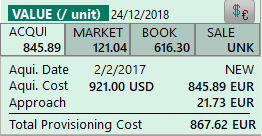
•Acquisition Cost
The Acquisition Cost is computed by AMS based on the history of this specific part. This is the purchase value of the part, which is displayed using the currency used to place the order (first value) and the conversion to the default currency (on the right side). The approach cost is the total cost of transport + Customs + Handling for this part, based of the cost distribution index of the associated AWB.
Note: Total Provisioning Cost = Acquisition Cost + Approach fees
•Market Value
The Market Value is computed by AMS. This value is the estimated current value of the part. This includes adjustment of acquisition cost depending on the current condition of the part compared to the condition when purchased (New / Overhaul condition / Repaired / Serviceable / Unserviceable).
•Book Value
The Book Value is computed by AMS. The Book Value is the residual value of the part, based on its acquisition cost, date of acquisition, and the amortization period defined for this type of material (P/N type) or for this specific part. You can define a specific amortization (or cancel a specific amortization to revert back to the period associated with this type of material) by clicking inside the "Book value" section.
[Book Value] = (1-Min(([Current Date] - [Date of acquisition]) / [Amortization period], 1)) * [Acquisition cost]
For example, if the amortization period of "rotable part" is 48 months and the part was purchased on 14/04/2021 for 1000 EUR, its book value on 21/09/2023 is:
[Book Value] = (1-Min(([Current Date] - [Date of acquisition]) / [Amortization period], 1)) * [Acquisition cost]
[Book Value] = (1-Min((890) / 1461, 1)) * 1000
[Book Value] = 390.83
If we calculate the book value of the same part on 1/1/2023:
[Book Value] = (1-Min((627) / 1461, 1)) * 1000
[Book Value] = 570.84
•Sale Value
The Sale Value is user defined (not computed by AMS) and is used to identify the parts which are for sale and the minimum amount the part must be sold for.
•Average Prices (Nomenclature)
As opposed to the above 4 values, the Mean Price is associated with all parts sharing the same P/N (Part Number) and is available in the NOMENCLATURE module. The Average Approach fees is the mathematical average of all approach fees (Transport + Customs + Handling) for all parts held in stock for this P/N.

02/ COMPUTATION ALGORITHM
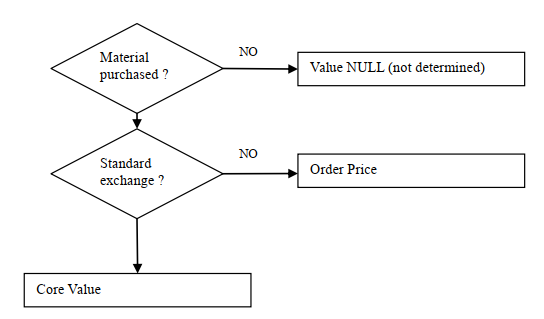
•Acquisition Cost
•Market Value
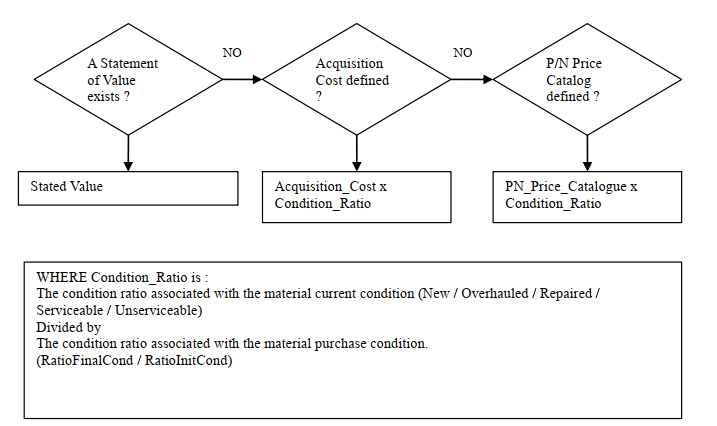
For example, if a part was purchased 2000 EUR in NEW condition, the part is currently in Serviceable condition (used), and the condition ratio associated with a Serviceable condition for a part effective to this aircraft type is 40% (0.40), the market value will be:
2000 x (0.40 / 1.00) = 800 (EUR)
•Mean Price (or Average Unit Price – AUP)
The Mean Price (Mean Unit Price) is the price of an item (P/N) in NEW condition. The Mean Price is calculated by AMS as follows:
Mean Price = Sum(ValCurValueNEW * Qty) / sum(Qty)
Where:
•ValCurValueNEW is the Acquisition Cost of all parts in stock, owned by your company, multiplied by the condition factor (if the part was not purchase in NEW condition then the condition factor is used to determine what the price would have been if the part was purchased in NEW condition)
•Qty is the quantity of parts
This formula applies to each parts having the same P/N (Part Number)
Warning: When a part was purchased but the condition of the part was omitted when the part was received, AMS will consider the part as being in Serviceable condition. This part will then be included into the calculation of the Mean Price for this P/N by applying a condition factor as define in the General Settings. Typically the condition factor for a part in serviceable condition is 60%, which will lead to a Mean Price of Purchase_Price x 1.00/0.60 = Purchase_Price x 1.66. It is therefore important to enter the condition of the part when received.